On the entire Dnieper between the rapids and the mouth of the Pripyat, there is no place more important in terms of trade than Kremenchuk.
Indeed, almost all salt operations with Belarus and Lithuania are concentrated in Kremenchuk – its main warehouses are in Kremenchuk (Kryukiv), and from there it is transported by water to Belarus. The main operations with lard intended for Warsaw take place in Kremenchuk; Jewish bankers live in Kremenchuk and the center of all Jewish credit operations in the middle Dnieper markets is located. Kremenchuk has a large trade in timber and timber products, which are rafted from above and from here diverge inland, in a direction perpendicular to the river. Kremenchuk is the terminus of daily steamboat connections with Kiev; The river upstream from Kremenchuk is still completely free of ridges and stones; downstream, rapids and fences already begin, so that it stands as if on the border between the rapids and the free part of the Dnieper. It also lies at the crossroads between Odessa and Great Russia: the great trade route from Odessa to Moscow always went through Elisavetgrad, Kremenchuk, and Kharkiv. Almost all trade in alcohol produced at the factories of the western part of the Kharkiv province, with the Katerynoslav and Tavria provinces, is concentrated in Kremenchuk. Finally, Kremenchuk is the first market from above, which in its grain operations gravitates towards Odessa: here the Pinsk region ends and the Black Sea region begins. Such are the circumstances that determine the commercial importance of Kremenchuk.
Kremenchuk and the town of Kryukiv, connected to it by trade interests, are located opposite each other: the first on the left, sandy, bank of the Dnieper, the second on the right, rocky. In Kryukiv, all the salt stores and salt loading take place; there is a collection point for Chumat trucks; in Kremenchuk, there is a forest pier, warehouses for alcohol and bread, and the location of all capital.
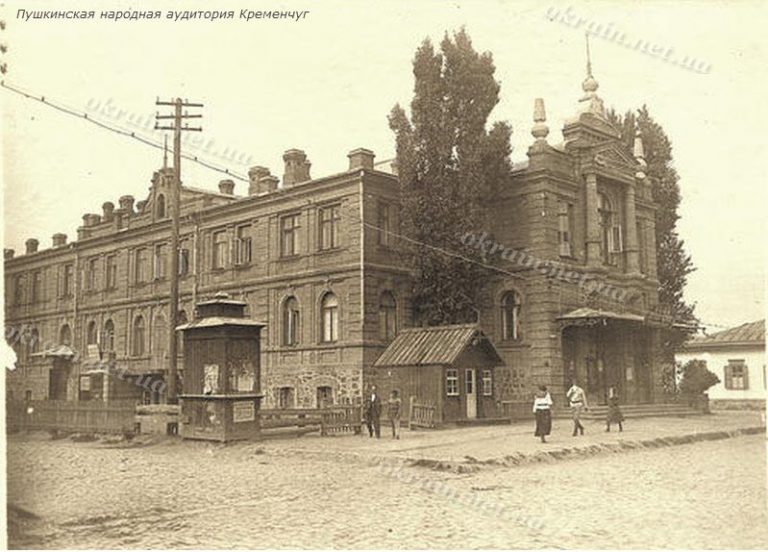
To notice in Kremenchuk signs of its commercial importance, you need to take a closer look at it, because the most essential attributes of a commercial city are not there. To begin with, the riverbank along the entire length of the city, which approaches it closely, has remained as it was, in its original form. Not a single stone has been laid, not a single pile has been driven in to make something resembling an embankment. Fortunately, the bank is sandy and there is no bottomless mud on it. At low water, loading is very inconvenient on the Kremenchuk side, and all trade is then concentrated in Kryukiv, where, thanks to some clearing of stones, the pier near the granite shore is much more convenient than the Kremenchuk one.
On the straight and rather beautiful streets of the city, you will look in vain for signs of a bank office. Despite the million-dollar turnover of Kremenchuk, the State Bank does not consider it necessary to have either a branch or an office there. There are many private bankers – all the commission agents of Pinsk lard merchants are engaged in discounts and loans, but they are, firstly, known only among Jews, and secondly, their credit is purely accidental: it is provided by the course of the salt trade, the amount of advance money with which they speculate; finally, it is extremely burdensome for trade due to its high cost.
The commercial importance of Kremenchuk in 1870 and a brief description of the city. (“Statistical study on grain trade in the Odessa region” by Y. Yanson)
Material provided by Serhiy Kardash
 TRX / USDT (TRC20)